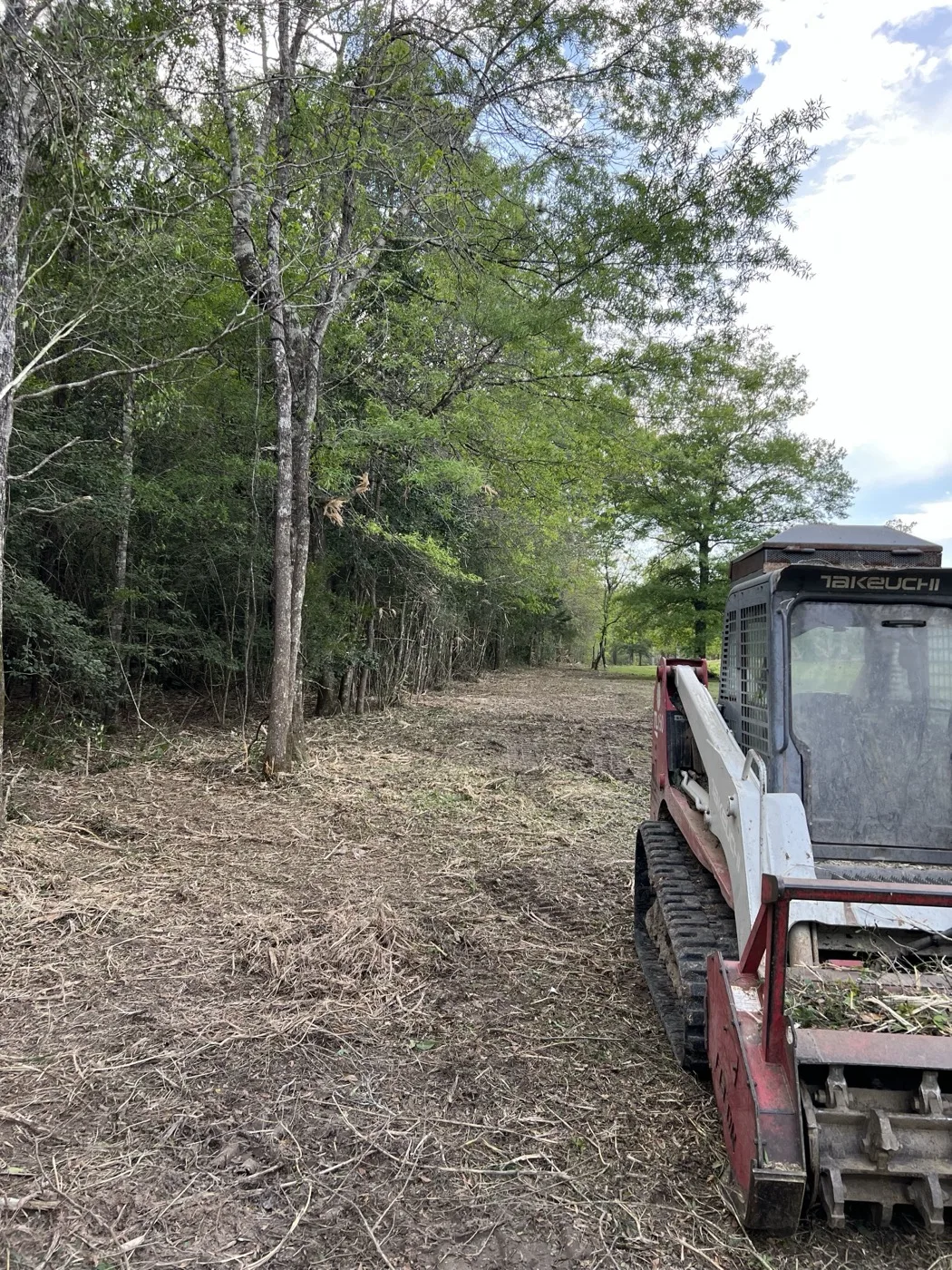
Forestry mulching vs. land clearing: which one does your property need?
Forestry mulching grinds brush and small trees into a mulch layer that protects the ground, and it leaves roots in place. Dozer clearing takes everything out, stumps and roots included, and leaves bare dirt you can build on. Overgrown land that needs opening up wants the mulcher. Land headed for a pad, pond, or driveway wants the dozer.
That is the short version. The right call depends on what is growing on your land, what the ground is doing, and what you want the place to become. Here is how we think through it on forestry mulching and land clearing jobs around Buna, Silsbee, and the rest of Southeast Texas.
What does forestry mulching leave behind?
A forestry mulcher is a drum of carbide teeth on the front of a tracked machine. It grinds standing brush, saplings, and small trees into chips right where they stand, in one pass. Stumps get chewed down to ground level, the roots stay in the dirt, and the ground ends up under a layer of fresh mulch instead of a scar.
Nothing leaves the property. There is no burn pile smoking for a week and no line of trucks hauling debris somewhere else. The mulch stays put, breaks down over time, and feeds the soil. In the meantime it takes the punch out of hard rain, which matters here. The Piney Woods catch 40 to 50 inches a year, and bare dirt on a slope does not stay where you left it.
The other thing a mulcher does well is pick its targets. A good operator can clean every bit of yaupon and briar out of a stand of pines without touching the trees you want to keep. That is how a choked, walled-off woodlot turns back into open woods you can see through and walk.
Tracked mulching machines also tread light. Purpose-built mulching tractors run ground pressures under 5 psi, so they keep working the damp bottoms and gumbo clay stretches that would bog or rut heavier iron. In a wet year, that difference decides whether the job happens at all.
What does dozer clearing do that mulching can’t?
Dozer clearing removes vegetation completely: pushed over, grubbed out, gone. Stumps and root balls come out of the ground instead of staying in it, and what you end up with is bare, root-free dirt that can be shaped, compacted, and built on. That below-grade cleanup is the whole reason the method exists.
It matters because wood left under a pad does not stay wood. Buried stumps and roots rot, the soil above them settles, and a slab or driveway poured over that spot cracks along the line of what used to be a root. Any ground headed for construction needs the organic material out of the footprint, not ground up and left in it.
Dozer work is also the honest answer for heavy timber. A mulcher head eats brush and small trunks all day, but past about 8 inches the grinding slows to a crawl. A blade pushes a mature pine over in seconds. When the growth gets big, the dozer wins on physics.
The trade-off is debris and disturbance. Pushing timber makes piles, and piles have to burn or leave on trucks. Burning on site is legal here under the right conditions, but debris from land conversion carries extra rules, and a county burn ban shuts the whole operation down until it lifts. Dozing also leaves bare dirt exposed until grass or gravel takes over. That is fine on a build site. It is less fine on ground you just wanted opened up.
Which method fits which job?
Neither machine is better. They are built for different endings, and the growth on your land plus your plans for it usually make the choice obvious:
| Forestry mulching | Dozer clearing | |
|---|---|---|
| Best growth | Brush, briar, saplings, trees to ~8” | Heavy timber, large trees, dense stands |
| Stumps and roots | Cut to grade, roots stay | Grubbed out completely |
| Debris | None, mulch stays as ground cover | Burn piles or haul-off |
| Ground afterward | Mulch blanket, soil protected | Bare, workable, root-free dirt |
| Keeper trees | Easy to work around | Harder to save |
| Wet ground | Low-pressure tracks tolerate it | Usually waits on dry weather |
| Ready to build on? | No, roots still in the ground | Yes, after grading and compaction |
As a rule: hunting land, overgrown pasture, fence lines, and woods you want opened up and kept green are mulcher jobs. House pads, barns, driveways, and pond sites are dozer jobs, because all of them need the roots out and the dirt worked afterward.
Does the brush come back after mulching?
Some of it, yes, and anyone who tells you otherwise is selling something. Mulching manages vegetation. It does not kill root systems, and the two plants that choke Big Thicket country understory both resprout from live roots. Texas A&M AgriLife is blunt about yaupon: clear it mechanically and the control is temporary without follow-up. Chinese tallow is worse. Texas carries an estimated 343 million tallow trees, concentrated in our corner of the state, and a cut stump sends up new shoots the same season.
None of that means skip mulching. It means plan on upkeep. The mulch layer holds regrowth down while it lasts, grass crowds out brush where it gets established, and a light maintenance pass every year or two keeps the land open for far less effort than the first clearing. Stubborn root systems can get spot herbicide. Land that gets no follow-up usually shows real regrowth within a year, which is exactly how most of the overgrown tracts we clear got that way in the first place.
Can you use both on the same property?
Most bigger jobs here use both, and that is usually the smart sequence. Mulch first to open the land up, see what you have, and protect the ground. Then bring the dozer into the specific footprint that needs to be buildable: the pad, the driveway line, the pond basin. The rest of the property keeps its mulch blanket and its keeper trees.
We run both machines, so the recommendation is not tied to whichever one happens to be on the trailer. Some properties get mulched fence line to fence line and never see a blade. Some get dozed corner to corner because the whole tract is going under construction. Most land somewhere in between. And if a pond is part of your plan, we wrote a separate guide to building a pond on your Texas property.
If you are weighing the two for a piece of land around Buna, Kirbyville, Evadale, or anywhere in Southeast Texas, the fastest way to a straight answer is walking it together. We look at the growth, the ground, and what you want the place to become, then tell you which machine the property needs. Call (409) 289-0802 or request a free estimate.